🛸 Elica Project: Support the Blog & Charity
Every tip on Ko-fi is split 50/50: 50% supports the site and 50% is donated to charity (currently supporting UNICEF). Check public receipts on our Transparent Donations page.
Visual note: many of the images on this blog are generated or edited using AI.
Choose Your Path! Click to expand the table of contents.
Table of Contents
PREFACE
Until recently, would you ever have believed that other major countries, beyond Japan, could produce anime of such outstanding quality and craftsmanship?
For years, we’ve associated top-tier animation almost exclusively with the Land of the Rising Sun. And yet, the global industry is changing at a breathtaking speed, churning out technical and narrative masterpieces from every corner of Asia (and beyond). Here are 5 fabulous non-Japanese anime that completely changed my perspective too!
5. Hitori no Shita: The Outcast (China)
Watch the key visual on Crunchyroll.
- Author: Based on the highly popular web manhua (Chinese comic) written and illustrated by Mi Er (originally published by Tencent).
- Genre: Action, Martial Arts, Supernatural, Urban Fantasy, Comedy.
- Where to watch: Available for streaming on Crunchyroll (early seasons are accessible on the platform).
What would happen if you were an ordinary 19-year-old college student like Chou Soran (Zhang Chulan in Chinese) and found yourself in your hometown graveyard late one night, ambushed by zombies and—even worse—face-to-face with an emotionless, psychotic girl wielding a massive knife?
That’s how the wild adventures of our hero begin! Raised by his now-deceased grandfather, who taught him martial arts while strictly forbidding him from ever using them, Soran discovers to his detriment that he is the heir to an incredible secret technique that many covet. However, as it turns out, some of these techniques require absolute purity of mind and body (meaning no women and no drugs).
Fu Houhou (Feng Baobao in Chinese), the mysterious girl, drags Chou into no-holds-barred battles between the Nadutong Express Delivery Co., Ltd.—which on the surface looks like a totally ordinary courier service, but is actually a secret government agency—and other factions, such as the primary antagonist Quan Xing Sect and the neutral yet powerful Orthodox Alliance, formed by the Tianshi Sect, the Wudang Sect, and the Great Clans.
All these sects compete for prestige and power, eager to lay hands on secret martial arts knowledge and uncover the dark secret hidden within Fu Houhou’s body.
The Outcasts (also called Outsiders) are the martial arts practitioners in this setting, endowed with immense supernatural powers.
The Major Factions Rooted in Mystical Taoist Imagery
Nadutong Express Delivery Co., Ltd: A secret para-governmental organization funded by the state that operates from the shadows under the guise of an express shipping company. Their main duty is to maintain public order and ensure regular people never discover the existence of supernatural powers. They represent law, stability, and restraint, aiming to integrate Outcasts into modern society.
Quan Xing Sect: The rebels and anarchists, serving as the main antagonists of the series. They seek to spread chaos for their personal gain, using deception, terror, and murder as their primary weapons. Some of their members belonged to prominent families within the Great Clans but betrayed or defected out of sheer ambition. They represent destruction in the spiritual world, driven mostly by the desire to claim the legendary Eight Mysterious Arts.
Orthodox Alliance: As the name suggests, this is a coalition of prominent families and prestigious martial arts schools that have controlled the spiritual world and Taoism for centuries. The Celestial Master, the Great Tianshi, is the most powerful and authoritative figure in the Outcast world. Their main goal is to protect the status quo and preserve ancient traditions.
Key Outcasts in the Narrative
Chou Soran (Zhang Chulan): Our protagonist. On the surface, he seems like a lazy, hormone-driven coward, but underneath he hides the mind of a cynical, calculating strategist. Having been forced to hide his powers his entire life, he developed a unique survival instinct. He uses the Golden Light Spell and the lethal White Lightning… provided he can maintain his much-debated purity!
Fu Houhou (Feng Baobao): The walking mystery of the series. She remembers nothing about her past, never ages, feels no conventional emotions, and speaks with a thick country accent. Despite her dazed demeanor, she is a natural-born fighter: possessing a monstrous amount of Qi and superhuman skill with kitchen knives. Her connection to Soran’s grandfather is the key to the entire story.
Wang Ye (Oya): A Taoist monk from the prestigious Wudang Sect. He looks like someone who is perpetually sleepy and lacks any motivation, but in reality, he is one of the most dangerous Outcasts in the world. He is the guardian of the Feng Hou Qi Men, one of the legendary Eight Mysterious Arts, allowing him to manipulate space, time, and the five elements at will within his range.
Zhuge Qing: The crowd favorite and prodigy of the immensely powerful Zhuge Clan. A master of Wuhou Qi Men (a martial art based on the historical strategies of Zhuge Liang), he is a charming, calm guy proud of his talent. His life and certainty will be completely upended after meeting Wang Ye and discovering the Mysterious Arts.
Zhang Lingyu: The favored disciple of the Great Tianshi and Soran’s spiritual “older brother.” He is the embodiment of elegance, composure, and righteousness within the Orthodox Sect. However, he harbors deep self-resentment (and a bitter conflict toward Soran): due to a youthful “misstep” with a woman, he lost the purity required to channel the pristine White Lightning, forcing him to rely on the dark, murky Black Lightning.
The Great Tianshi (Zhang Zhiwei): The elderly supreme leader of the Tianshi Sect and, quite frankly, the most powerful Outcast on the planet. He appears as a sly, humorous, relaxed old man, but beneath his robes lies god-level power. His mastery of the Golden Light Spell is so vast that he can subdue whole groups of elite enemies effortlessly. He is the most respected figure in the spiritual world, though he too guards heavy secrets regarding Soran’s grandfather’s past.
Xia He (The “Bone Scraper”): One of the flagship members of Quan Xing’s “Four Madmen.” She is a fatal, magnetic woman with a provocative look, possessing terrifying power: she can manipulate and drastically amplify men’s lust and carnal desires. Her victims lose their sanity completely, destroying themselves just to please her. Despite her ruthlessness, she occasionally displays a quirky personal ethic and a strong interest in Zhang Lingyu.
Lu Liang: A cold, cynical young man who always looks bored. He belongs to the prestigious Lu Clan, but betrayed his family to join the Quan Xing rebels. He wields the magical ability Ming Hun Shu (Soul Processing/Manipulation), allowing him to extract, alter, cut, and “stitch” people’s memories and souls like digital files. He is the mastermind behind defiling Soran’s grandfather’s grave, obsessed with unearthing the secrets of the Eight Mysterious Arts.
My Take: A Whirlwind of Naruto, Hunter x Hunter, and Bungo Stray Dogs
What immediately catches your eye when watching this donghua is how it manages to fuse elements from some of the most successful Japanese works of all time into a single, overwhelming whirlwind. The structure of the second season, centered around the Tianshi Sect’s legendary tournament, brings back nostalgic vibes and the ensemble feel of the unforgettable first part of Naruto and its Chunin exams.
But it doesn’t stop there: the tactical complexity of powers nods to the combat system of Hunter x Hunter, while the management of secret factions in a modern urban setting closely mirrors the dynamics of Bungo Stray Dogs.
On the other hand, it’s a running joke that Chinese productions tend to “copy” giant Japanese anime hits. In this case, however, the creators knew how to draw fantastic inspiration from past classics to elevate their craft, infusing everything with a strong cultural identity rooted in Taoist philosophy and local folklore. The result is a fresh, strategic, and damn enjoyable show.
With 6 seasons under its belt, it’s a work I highly recommend if you’re looking for a battle shonen with a solid, mature, and well-structured setting. The only slight drawback, in my opinion, lies in the visual presentation of certain secret techniques: at times, the digital effects and artwork feel a bit overly flashy and baroque.
In those moments, less would have been more, and the cluttered visuals take away a bit of the overall sharpness and cleanliness. Still, nothing that ruins what is genuinely a great overall experience.
🕯️ 𝔖𝔥𝔞𝔡𝔬𝔴 𝔦𝔫 𝔬𝔲𝔯 𝔖𝔬𝔲𝔩𝔰 👁️🗨️
“When a man with a pistol meets a man with a rifle, the man with the pistol is a dead man. But when you meet a sociopathic girl… you’re the dead one!”#
4. Tower of God (South Korea)
Check out the key visual on Reddit.
- Author: Based on the immensely popular Korean manhwa/webtoon written and illustrated by SIU (Slave In Utero), one of the absolute pillars of the Naver Webtoon platform.
- Genre: Action, Adventure, Dark Fantasy, Mystery, Psychological.
- Where to watch: Available for streaming on Crunchyroll (which co-produced the anime).
Twenty-Fifth Baam is a kid definitely immune to claustrophobia: he managed to live from an early age, for an unknown amount of time, in the total darkness and solitude of a mysterious cave.
His only lifeline is Rachel, a girl who stayed close to him, teaching him how to speak, acting as his mentor and almost as an older sister, telling him about the fantastic outside world. Rachel, however, is obsessed with an unshakeable desire: “to see the stars and the true sky.”
To do so, she decides to enter the “Tower of God,” a colossal structure made of an unknown number of floors, where it is said that anyone who reaches the top can have any wish granted. Baam decides to follow her, but the two are teleported to different areas and immediately lose sight of each other.
Finding himself on the ground floor, the boy must immediately face Headon the Caretaker, who subjects him to a ruthless trial: popping a balloon protected by a gigantic white steel eel. Luckily for him, Princess Yuri Zahard, witnessing the scene, decides to lend him the legendary Black March, a priceless magical sword. Thanks to it, Baam succeeds, but is immediately teleported away before he can even return the weapon to its rightful owner.
An Everlasting Fusion of Genres
Take the archetype of the classic “Ascending Tower” so dear to lovers of Dungeons & Dragons-style role-playing games, combine it with the tension of modern Battle Shonen and the psychological challenges typical of Escape Rooms; add a splash of school fantasy, a dash of the traditional hero’s journey, and garnish it all with fierce betrayals, unexpected alliances, and sensational plot twists.
What comes out of it is an exquisite and irresistible recipe. In this setting, our naive protagonist will have to face the hard coming-of-age dramas, learning to survive the ruthless logic of a pyramidal society dominated by the law of the strongest. Each floor of the Tower hides lethal challenges, unique ecosystems, and increasingly godlike opponents… with the suspicion that, on the highest peak, resides “God” Himself.
The Magic System
The entire structure of the Tower is permeated by Shinsu, a mysterious water-like substance that acts as both air to breathe and a source of magical energy. The higher you go, the more crushing the density of Shinsu becomes, requiring extraordinary physical and mental endurance.
Regulars vs. Irregulars: The “Intruders” of the Tower
In the rigid system of the Tower, a social and political distinction exists that decides everyone’s fate: that between Regulars and Irregulars. The Tower itself (or rather, its enigmatic caretaker Headon) carefully selects who among the inhabitants of the Outer Tower is worthy of embarking on the climb; these chosen ones are called Regulars and enjoy the legal right to climb floor by floor by taking tests.
On the contrary, anyone who manages to open the doors of the Tower from the outside under their own power without being invited—just like Baam and Rachel—is branded with the title of Irregular.
In the series’ setting, Irregulars are regarded as dangerous intruders, anomalies in the system capable of breaking the physical laws of Shinsu. Since historically Irregulars have always brought chaos, revolution, and destruction, anyone entering this way is constantly subjected to suspicion, ruthless hunting, and severe punishment if discovered by the authorities and Rankers who maintain order.
The Structure of the Tower: A World Within a World
Forget the idea of a classic tall, narrow medieval tower. In Tower of God, the Tower is a true universe unto itself. Each individual floor is the size of an entire continent, with its own climates, nations, fauna, and laws. The structure is mainly divided into three macro-areas:
1. The Outer Tower: The residential area where people are born, grow up, and live normal lives, knowing almost nothing about what happens on the upper floors.
2. The Inner Tower: The restricted area where “Regulars” (those chosen to climb the Tower) take tests to ascend to higher floors.
3. The Middle Area: The transition zone connecting the inner and outer towers, used by caretakers and Rankers (those who have already completed the climb).
The “School” for Regulars: The Academy of Positions
Once inside the Inner Tower (starting from the legendary second floor, known as “Evankhell’s Mothership / Test Floor”), candidates don’t just fight randomly; they are placed into an actual schooling and examination structure. Here, Regulars are divided and trained based on their aptitudes into five core tactical positions, just like a party in an RPG:
Fisherman: The frontline warrior, specialized in close-quarters combat and inflicting as much damage as possible.
Spear Bearer: The group’s sniper, supporting teammates from the rear by taking down targets at a distance.
Scout: The eyes and ears of the team. Moves in the shadows to gather intelligence on the enemy and guide attacks.
Light Bearer: The tactician and battlefield director. Uses “Lighthouses” (floating cubes of light) to map the battlefield, illuminate dark areas, and coordinate team movements.
Wave Controller: The group’s “mage,” capable of directly manipulating Shinsu to heal allies, immobilize enemies, or unleash devastating attacks (the role where our Baam will shine).
The Tests: More Than Just a Clash of Strength
The tests to ascend floors never boil down to a simple “whoever is strongest wins.” The Tower’s administrators love games of wit, strategy, and logic. Just think of the infamous Crown Game or survival tests styled like “cops and robbers.”
Many tests are structured to force candidates to cooperate, but at the same time sow the seeds of doubt: in a system where spots to advance to the next floor are limited, today’s classmate could be the rival to stab in the back tomorrow. This constant climate of psychological tension makes every test a deadly chessboard where intelligence and ruthlessness often count far more than brute force.
Key Characters
Khun Aguero Agnes: The tactical brain of the group and, let’s face it, one of the most beloved characters in the entire work (and my personal favorite too). A disowned member of one of the Tower’s most influential Great Families, Khun compensates for his lack of colossal brute strength with a devilish intellect, cynicism, and an extraordinary ability to manipulate people and test rules.
Equipped with his multifunctional magical bag (the Manbarondenna), he quickly becomes Baam’s protector and best friend, leading the team with the strategies of a ruthless chess player.
Rak Wraithraiser: A gigantic warrior resembling an anthropomorphic alligator, obsessed with hunting and finding “strong prey” to slay to prove his supremacy. Despite his appearance as a ruthless monster, Rak soon proves to be the emotional backbone (and ultimate comedic relief) of the main trio. Notable for his habit of calling all other humans “turtles” (dividing them into black turtle, blue turtle, etc.) and his unexpected passion for chocolate bars.
Rachel: The catalyst character for the entire story and, without a shadow of a doubt, one of the most controversial, discussed, and “hated” figures in global webtoon history. She possesses no special powers, is not a skilled fighter, and is driven by deep repressed envy and a selfish obsession with seeing the stars at any cost.
Her character perfectly embodies the harsh reality of the Tower: an ordinary person willing to commit the worst vileness and fiercest betrayals just to avoid being left behind in the dark.
Yuri Zahard: One of the legendary “Princesses of Zahard” and a top-level High Ranker (having already completed the climb and being among the most powerful beings overall). Beautiful, rebellious, impulsive, and endowed with frightening physical strength, she breaks the Tower’s rules by descending to the first floor out of sheer curiosity about the Irregular, Baam.
She is the one who lends him the legendary Black March sword, kicking off the entire chain of events and continuing to watch over him from above.
Lero-Ro (The “Teacher” of the Tests): An elite Ranker working as an administrator and instructor on the Tower’s second floor. With his blonde hair, headband, and trusty “lantern,” he immediately assumes the role of a true professor for the candidates.
He is the one who explains the ruthless rules of Shinsu, holds theoretical lessons on combat positions, and manages the most crucial tests. Despite his terrifying strength (which he displays effortlessly to weed out the weak), he is an unusually fair, empathetic examiner who is mindful of system injustices, ultimately developing a strong fondness for young Baam.
Endorsi Zahard (Androssi): Another of the famous “Princesses of Zahard,” but unlike Yuri, she is still a Regular climbing the floors from the beginning. Beautiful, arrogant, self-centered, and with an unbridled passion for fashion, Endorsi is an exceptional fighter (Fisherman class) capable of wiping out entire teams single-handedly.
Behind her seemingly superficial and ruthless exterior lies a tragic past of abuse and desperate struggles for survival in which she had to “devour” her own adopted sisters to catch the King’s eye.
Shibisu: The classic “average guy” dressed in a purple tracksuit who seems to have ended up there by accident. In a world populated by monsters of strength, divine princesses, and tactical geniuses, Shibisu possesses no special Shinsu skills nor superhuman physical strength.
Yet, thanks to extraordinary emotional intelligence, great tactical intuition, and unwavering loyalty to his friends, he manages to pass impossible tests, quickly becoming the emotional glue and charismatic leader of one of the strongest candidate teams in the Tower.
My Take: Highs and Lows Between Psychological Finesse and Inconsistent Pacing
Overall, the work is well-written and decidedly successful. Its ace up the sleeve is undoubtedly an exceptional and massive cast of characters, where many supporting figures get their own time in the spotlight.
In fact, quite often, even the protagonist Baam temporarily steps off-stage to make room for the stories and development of other group members. In Tower of God, psychology and introspection matter tremendously, taking on far greater importance than basic power system mechanics.
On the technical side, the art style is nice but unfortunately inconsistent from episode to episode, showing some obvious visual shortcomings. However, my biggest critique lies in the pacing: at certain points, the narrative slows down noticeably.
Sometimes, right where you’d expect devastating fights or high-density story events, the action feels almost “neutered,” chopped up or delayed by constant scene changes focusing on far less interesting situations.
We are undoubtedly talking about an atypical battle shonen, far removed from classic “power fantasy” clichés at all costs, but this pacing management sometimes risks leaving a bit of a bitter taste in your mouth. Despite these flaws, I still highly recommend watching it, especially season two. As a reminder, the anime currently has 2 seasons out.
🕯️ 𝔖𝔥𝔞𝔡𝔬𝔴 𝔦𝔫 𝔬𝔲𝔯 𝔖𝔬𝔲𝔩𝔰 👁️🗨️
“Baam… just go to the registry office and change your name, we know you’re a foreigner! And no, showing up in season two under a fake name like Jue Viole Grace won’t help you bypass tax audits, it just makes you look like a 14-year-old emo who just discovered nicknames on Discord!”
3. Release That Witch (China)
Check out the key visual on Crunchyroll.
Author: Based on the famous web novel written by Er Mu (二目), which became an immensely successful global manhua and was eventually adapted into an animation.
Genre: Isekai, Fantasy, Kingdom Building, Sci-Fi/Engineering, Politics.
Where to watch: Available on official Chinese animation platforms such as Tencent Video / WeTV and authorized YouTube channels.
«Hi! I’m a spoiled, selfish, and ignorant prince who executes innocent women just because the Inquisition says witches are evil.»
«Hi! I’m your new “me.” I took over your body, I’m a brilliant engineer and politician from modern-day China, and I’m going to save this country from ruin by hiring witches as specialized employees and empowering talented people!»
That’s exactly how this atypical isekai kicks off. The fourth prince of the Kingdom of Graycastle, Roland Wimbledon, finds himself confined to the poor and dangerous border town of Border Town. Possessed by the soul of a modern-day mechanical engineer, the prince radically changes the world’s perspective through science, carrying out a premature political, economic, and industrial revolution in the past!
Naturally, the challenge won’t be a walk in the park: threats abound in Border Town, and every winter the citizens must contend with devastating attacks from monsters, demonic creatures, criminals, and corrupt, evil nobles.
The Industrial Revolution: When Thermodynamics Meets Magic
The true stroke of genius in Release That Witch lies in how Roland decides to approach magic. For centuries, the kingdom and the Inquisition saw witches’ powers as a demonic curse to be eradicated with fire.
Roland, like a good mechanical engineer, applies a purely scientific point of view instead: what if magic were simply a measurable, quantifiable, and harnessable form of energy?
Instead of burning them at the stake, the prince turns witches into the driving force behind an accelerated industrial and technological revolution, applying the laws of modern physics to a medieval setting and creating an insane kingdom-building system:
Precision Metallurgy and Chemistry: Harnessing the powers of witches like Anna (capable of manipulating fire and raising its temperature to unimaginable levels), Roland builds the first industrial blast furnaces.
The result is the production of high-strength steel, ultra-pure alloys, and subsequently, sulfuric acid, reinforced concrete, and standardized gunpowder.
The Twilight of the Knights (The Military Revolution): Who needs enchanted swords or heavy armor when you can count on ballistics? Roland introduces mass production of breech-loading rifles, artillery cannons, and advanced ammunition to Border Town.
Corrupt nobles and criminals, convinced that their cavalry charges and old tactics make them invincible, find themselves literally swept away by the superiority of lead and gunpowder.
Living Assembly Lines: Every witch is integrated into society as a specialized resource in a modern factory. There are those who deform metals at a molecular level acting like a human milling machine, those who generate ice to preserve food and cool engines, and those who control plant growth to defeat winter famines. What the Church called “sin,” Roland calls resource optimization and corporate efficiency.
In no time at all, Border Town transforms from a cluster of mud huts into an industrial metropolis complete with smokestacks, steam engines, railways, and telegraph lines. An absolute joy for anyone who loves seeing logic and science bend the rules of classic fantasy.
Main Characters
Roland Wimbledon (Cheng Yan): The absolute protagonist of the work. In his previous life, he was a brilliant Chinese mechanical engineer who died from overwork and reincarnated into the body of the fourth prince of the Kingdom of Graycastle. Instead of indulging in the high life or panicking, Roland uses his encyclopedic scientific knowledge to transform a backward fiefdom into an industrial superpower.
He is a charismatic, pragmatic, fair, and completely unbiased leader who sees witches not as monsters, but as the key to scientific and social progress.
Anna: The first witch saved from the stake by Roland and, without a doubt, the backbone of all industrial production in Border Town. Initially shy and traumatized by Church persecutions, thanks to Roland she finds her voice and a purpose. Her power consists of generating and manipulating a special magical fire, whose flames can reach frightening temperatures or be shaped like precision blades.
This ability makes her the ultimate “milling machine and welder,” fundamental for heavy metallurgy and the creation of the first steam engines. Moreover, she seems secretly (or not so secretly) in love with the prince.
Nightingale (Veronica): An elite member of the Witch Cooperation Association, she is the one who initially infiltrates Roland’s castle to test his intentions. Impressed by his goodness and vision of the future, she becomes his shadow and his most loyal personal bodyguard.
Her power allows her to enter a “misty dimension,” rendering her invisible and intangible, alongside a passive ability to instantly perceive if someone is lying. She is the invisible military force protecting Roland from the plots of corrupt nobles.
Nana Pine: The very young and sweet native witch of Border Town. At first, she is just a little girl terrified of her own power, hidden by her father out of fear of the Inquisition. When Roland discovers her, instead of condemning her, he immediately hires her as the town’s “chief medical officer.”
Her power allows her to instantly heal deep wounds and regenerate biological tissues. She becomes an irreplaceable asset for Roland, allowing him to eliminate casualties among his troops during the first brutal winter clashes against demonic beasts.
Barov Mons (The Old Advisor): An elderly, meticulous official sent directly from the capital to serve as Roland’s assistant and treasurer. At the start of the story, he is a desperate man: convinced that Roland is the usual incompetent, spoiled prince destined to sink Border Town.
When the protagonist starts implementing his crazy scientific ideas, Barov constantly switches between nervous breakdowns and states of total shock as he watches the laws of bureaucracy and economics get rewritten overnight. Despite the frequent near-heart attacks caused by the prince’s antics, he proves to be an extraordinarily loyal and efficient administrator, becoming Roland’s right-hand civilian man.
Sir Carter (The Knight): The Chief Knight of Border Town. He perfectly embodies the stereotype of the old-school medieval warrior: all honor, sense of duty, formal charges, and sword fighting.
Initially, he looks at Roland’s plans with massive skepticism, considering the idea of training illiterate peasants to use firearms—not to mention collaborating with witches—absurd and “unhonorable.” However, his ironclad loyalty to the crown compels him to obey blindly, ending up literally jaw-dropped at the devastating effectiveness of modern military science.
Corrupt Nobles and the Inquisition (The Villains): The main antagonist front of the first season, represented primarily by Duke Ryan (the greedy lord of the nearby Longsong Stronghold) and the judges of the Church. These enemies embody the perfect mix of medieval obscurantism and political ruthlessness.
On one hand, the corrupt nobles want Roland to fail so they can seize Border Town and maintain their feudal privileges based on exploiting the poor; on the other hand, the Inquisition uses religious fanaticism and witch hunts as a ruthless tool of terror to brainwash the masses and maintain absolute control over the kingdom. They will be the first to experience the power of bullets and gunpowder firsthand.
Our Take: Unexpected Entertainment and Narrative Simplicity as a Strength
I’ll admit it! The episodes of the first season flowed like water down a waterfall. Every time I watched an episode, time literally flew by, leaving me thinking: «Damn it, you can’t leave me with a cliffhanger like that!».
This anime possesses an innate and captivating ability to entertain the viewer, even though it rests on a simple structure and narrative tropes that have been seen time and again, tweaked here just enough. And let me tell you, it works damn well.
The opening theme, absolutely epic, and the overflowing charisma of the protagonist Roland dominate a show of genuinely unexpected overall quality. Even from a purely visual perspective, the art style and the fluidity of the animation turn out to be very pleasant and polished.
The main flaw? The first and only season currently released has very few episodes, leaving you with a desperate craving to continue the story. Other than that, if you love management games and building kingdoms from scratch, I highly recommend it.
🕯️ 𝔖𝔥𝔞𝔡𝔬𝔴 𝔦𝔫 𝔬𝔲𝔯 𝔖𝔬𝔲𝔩𝔰 👁️🗨️
“Anna is the housewife everyone wishes for: she saves you a fortune on heating bills, can cook over low or medium heat without ever making a fuss, and lights your fireplace instantly with zero effort. Thank you for existing, Anna!”
2. Dragon Raja (China)
Check out the key visual on Reddit.
Author: Based on the immensely famous and epic novel series written by Jiang Nan (江南), one of the most widely read and beloved urban fantasy works in its homeland.
Genre: Urban Fantasy, Action, Supernatural, Sci-Fi, School/Academic.
Where to watch: Available on the official Chinese platform Tencent Video / WeTV.
Lu Mingfei is an extremely unlucky eighteen-year-old. Cast aside by his parents, he lives with an aunt and uncle who treat him as the perpetual black sheep of the household. Things are going just as poorly on the friendship and romance fronts, especially after developing a massive crush on an opportunistic girl who turns out to be a ruthless social climber.
Just as he is awaiting graduation and resigned to a mediocre life, his existence is turned upside down by a mysterious invitation to the prestigious and ultra-secret Kassel College.
Catapulted into this academy, Lu Mingfei discovers a shocking reality: the world is populated by human hybrids with dragon blood. The members of Kassel are capable of using Yanling (or Kotodama), magical words in ancient Draconic capable of unleashing devastating elemental powers.
The protagonist cannot fathom why he was recruited, considering himself a complete useless loser, but the entrance tests reveal an incredible truth: he possesses Grade S dragon blood, the rarest, purest, and most powerful of all.
However, his troubles have only just begun. Lu Mingfei discovers he harbours a dark and powerful entity within himself who calls himself Lu Mingze, appearing in the guise of a younger brother.
This being does not seem like a dragon or a deity at all, but acts in every way like the Devil: he constantly offers him divine powers to pull him out of tight spots, but demands years of his life or excruciatingly high prices in return. Even though the boy almost always refuses the pact, Lu Mingze often finds himself forced to save him using various tricks and loopholes to protect his host and, consequently, himself.
The anime thus delves into the mysteries of the ancient dragon pantheon and the visceral hatred that hybrids hold for them. In the lore of Dragon Raja, the most powerful dragons are always born as twins.
Legend has it that millennia ago, the two supreme rulers, the Black King and the White King, clashed in an apocalyptic battle that saw the defeat of the Black King. But after centuries of apparent peace, time is running out: the Ancient Dragons are awakening and ready to reclaim their throne…
The Eternal Clash Between the “Devil” and Man
One of the most psychologically dense and interesting aspects of this work is undoubtedly the endless mental tug-of-war between Lu Mingfei and Lu Mingze. It is an eternal battle between the boy’s earthly desires and the supremacist vision of an extraordinarily powerful being, who nevertheless has to grapple with a massive paradox: his very existence depends entirely on a lowly, fragile human being.
This “Faustian” dynamic keeps the viewer constantly on the edge of their seat. Lu Mingze looks down on the world, yet he is chained to Mingfei. As you keep watching, you can’t help but wonder: is it all just a ruthless manipulative game, or will the entity eventually grow genuinely attached to that wretched, unlucky human? A doubt that colors the work with truly magnificent dark shades.
The Hierarchy of Kassel College: Blood, Power, and Politics
You don’t get admitted to Kassel College through academic merit or human connections. The entire structure of the academy is pyramidal and based on strict rules, where every student’s status is defined by genetic factors, student factions, and secret military departments:
1. The Grade System (The Purity of Dragon Blood)
A hybrid’s value is determined by the percentage of draconic blood flowing through their veins, classified on a letter scale from bottom to top:
Common Grades (Grade B, C, D): They represent the majority of the student body. They have limited powers and are trained primarily for support, research, or logistical roles.
Grade A: The elite of the College. Extraordinary students like Caesar Gattuso and Chu Zihang. They possess devastating Yanling and off-the-charts physical capabilities, representing the frontline defense against the dragon threat.
The Mythological Grade S: The highest and most unstable level. It is so rare that prior to Lu Mingfei‘s arrival, they could be counted on one hand in the college’s history. Grade S hybrids possess godlike potential, but walk a constant tightrope: if their dragon blood percentage exceeds the 50% threshold, they risk transforming into bloodthirsty, ruthless monsters known as Death Servants.
2. Principal Anjou (The Absolute Pinnacle)
Above everything and everyone stands the charismatic and feared Principal Hilbert Ron Anjou. Despite appearing as an elegant, sprightly gentleman over a hundred years old dressed in tailored suits, Anjou is the deadliest living dragon slayer. His visceral hatred for the dragon lineage drives the college’s entire policy. His Yanling, “Time Zero”, allows him to slow down time around himself, making him virtually invincible in combat.
3. The Cold War of Student Factions
Daily life at the college is split in two by the rivalry between its two most powerful student clubs, competing for political influence and campus resources:
The Student Union: Led by the charismatic, ultra-wealthy, and egocentric Caesar Gattuso. It is the faction of the “privileged,” characterized by a luxurious lifestyle, lavish parties, and a noble demeanor. Caesar runs the union like a true monarch.
The Lionheart Society: The oldest club in the college, currently led by the cold, rigorous, and formidable Chu Zihang. In contrast to the Student Union, the Lionheart Society focuses on strict military discipline, extreme training, and the academic study of dragon weaknesses.
4. The Execution Department (The Secret Service)
Led by the stern and scarred Professor Schneider, this department serves as Kassel’s dark military arm. It is made up of elite field agents dispatched worldwide to contain biological threats, cover up the existence of dragons from ordinary humans, and mercilessly “terminate” hybrids who have lost control of their draconic nature.
5. Norma (The Artificial Intelligence)
Coordinating all administrative tasks, cybersecurity, and even field operations is Norma, the college’s sentient quantum supercomputer. Norma monitors everything, calculates mission success probabilities, and assigns academic grades. She is the invisible eye holding Kassel’s entire infrastructure together.
Dragon Raja’s Power System: Between Genetics and Words of Power
Unlike other fantasies where magic is an abstract energy anyone can learn through study, in Dragon Raja power is purely genetic, biological, and ruthless. The power system rests on two fundamental pillars: blood purity and words of power.
1. Blood Percentage and the Critical 50% Limit
A hybrid’s power depends on the percentage of draconic genome in their DNA. The higher this percentage, the stronger, faster, and more superhuman their reflexes become. However, there is a terrible price to pay: The Critical 50% Limit.
If the draconic portion exceeds half of the host’s DNA, the dragon gene takes absolute control. The hybrid loses their mind, their human consciousness is erased, and their body mutates into a Death Servant, a hideous, mindless monster that obeys only ancestral dragons. Because of this, Kassel students walk a constant tightrope over the abyss of madness.
2. Yanling (Kotodama): Words of the Spirit
The active core of combat revolves around Yanling (called Kotodama in the Japanese adaptation). These are spells and reality manipulations that hybrids can activate by incanting formulas in the ancient Draconic language. There is a literal “Periodic Table of Yanling,” dividing them by elements (Fire, Water, Earth, Wind, Light/Spirit) and danger levels (from harmless to forbidden).
Every hybrid, based on their bloodline, unlocks a specific Yanling that defines their combat style. Here are a few insane examples showcased in the first season:
- Kamaitachi (Scythe of the Wind) – Caesar Gattuso: Allows Caesar to control the wind to amplify his hearing to sci-fi levels. He can map an entire battlefield simply by listening to enemy heartbeats, weapon reloads, or rustling leaves miles away.
- Jun Yan (Royal Fire) – Chu Zihang: A high-risk, almost forbidden Yanling. Chu Zihang can generate flames of unheard-of violence, creating thermal explosions and fire barriers capable of melting steel in seconds.
- Time Zero – Principal Anjou: One of the rarest and most devastating Yanling in existence. It allows him to accelerate his reflexes and movements to such a speed that surrounding time appears to literally stop. For Anjou, an entire lethal duel lasts merely a fraction of a second.
3. Lu Mingfei’s Anomaly: “Something for Nothing”
And what about our protagonist? Being a theoretical Grade S, everyone expects a world-ending Yanling from him. In reality, Lu Mingfei’s true power lies in his bond with the “Devil” Lu Mingze. When Mingfei is backed into a corner and decides to trade a quarter of his soul, the special Yanling “Something for Nothing” activates.
This power doesn’t follow the rules of the periodic table: it allows Lu Mingfei to “borrow” any existing Yanling, boost it to its maximum level, and instantly heal from mortal wounds. It’s a completely broken, cheat-like power system that temporarily makes him a god on Earth at the appalling cost of his own lifespan.
Mysteries and Speculations: The Pillars of the Series
If there’s one thing keeping Dragon Raja fans glued to their screens (and spending hours on forums racking their brains), it’s the amazingly dense web of secrets, conspiracies, and unresolved questions.
The entire narrative isn’t content with just showing spectacular fights between hybrids and dragons; it constantly drops clues, half-truths, and whispered legends that turn watching into a true investigative game.
Here are the main mysteries serving as the core pillars for the entire work:
Who are Lu Mingfei and Lu Mingze really?: That’s the million-dollar question. The connection between the protagonist and the blonde “Devil” is shrouded in total mystery. Are they truly brothers? Are they the same person split in two, with Mingze representing the sealed draconic half?
Or perhaps, considering that the most powerful Dragon Kings are always born in pairs as twins, are the two of them the human reincarnation of one of those royal couples? Every clue provided by the anime only fuels conflicting yet endlessly fascinating theories.
The Dragon Kings’ Resurrection Cycle: The mythology of Dragon Raja tells us that Dragon Kings cannot truly die for good; they can only be put to sleep, only to wake up in a continuous cycle.
Who is accelerating this process in the present? And above all, what role does the legendary primordial clash between the Black King and the White King play in humanity’s destiny? Someone in the shadows is clearly pulling the strings to collapse the fragile balance between humans and dragons.
The Dark Truth Behind Kassel College: The academy presents itself as a beacon of hope and progress for hybrids, but beneath its gilded surface lies unsettling ruthlessness. How far will Principal Anjou go to fulfill his personal vendetta against the dragons?
The genetic experiments conducted in the college’s secret labs and the merciless handling of “Death Servants” raise a gigantic ethical question: are the true monsters the dragons, or those who hunt them?
This constant feeling that every character hides an ulterior motive, a dark past, or an unspeakable secret is what makes Dragon Raja‘s plot so magnetic, driving viewers to analyze every single frame in search of clues.
Choosing a “Favorite” Character is a Challenge
One of the other dilemmas (and greatest strengths) of this work is… how do I choose a favorite character? They are all ridiculously exceptional, each with their own strengths and flaws! Would you prefer the beautiful, resourceful, and intelligent Nono?
The immensely powerful, authoritative, and charismatic Principal Hilbert Ron Anjou? The tormented duality of Lu Mingfei and Lu Mingze, with the charm of “unlucky good allied with lucky evil”?
Or the prestige, ego, intellect, and innate leadership of Caesar Gattuso? Not to mention the strength, determination, pride, and honor of Chu Zihang, or Finger von Frings, the slacker, hilarious friend who nevertheless hides massive power and secrets.
These, along with many other characters introduced later on, are simply impossible not to praise.
My Take: A Mind-Boggling Budget and Spine-Tingling Mysteries
The work boasts fantastic writing, and as you’d expect with such a massive story, the anime likely had to cut a few things compared to the original novels. In some ways, it shows a bit of the same issue I pointed out earlier with Tower of God regarding directorial cuts and pacing shifts.
But here there’s a substantial difference: the stakes, the dots to connect, and the mysteries are so dense and thrilling, and the characters so extraordinarily well-crafted, that I literally get goosebumps just thinking about it.
Even when the direction decides to cut away right in the middle of a crucial moment to switch to less intense events, you never get bored. You still find yourself sitting there speculating, coming up with theories, and racking your brain: “Wait, so that means… ah, and that other thing must be…!”. In short, a non-stop “Wow!” factor that keeps you glued to the screen.
Visually speaking, the artwork and animation are mind-blowing; you can tell from a mile away that there’s a colossal budget behind it. The anime currently has two seasons out, and the second is by far the best so far, precisely because the first serves as a purely introductory setup. Don’t waste any more time: go watch it!
🕯️ 𝔖𝔥𝔞𝔡𝔬𝔴 𝔦𝔫 𝔬𝔲𝔯 𝔖𝔬𝔲𝔩𝔰 👁️🗨️
“Lu Mingfei, I brought you flowers.” (Find out why!)
1. Lord of Mysteries (China)
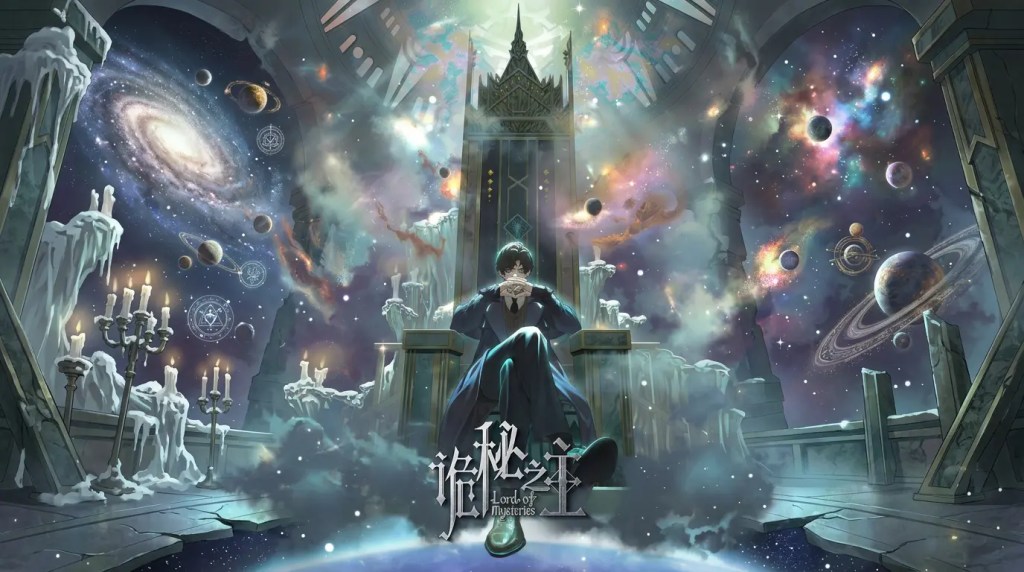
(Original AI-generated image, 5 Fabulos Non-Japanese Anime)
Check out the key visual on Reddit.
Author: Based on the legendary and acclaimed web novel written by Cuttlefish That Loves Diving (爱潜水的乌贼), a work with worldbuilding so immense and detailed that it pales the great classics of Western fantasy.
Genre: Mystery, Steampunk, Cthulhu Mythos, Psychological Fantasy, Supernatural, Adventure.
Where to watch: Available on the official Chinese platform Tencent Video / WeTV.
Are you familiar with the dark universe of H.P. Lovecraft? Have you ever read his works of pure cosmic horror, or perhaps played the classic tabletop RPG Call of Cthulhu? And what about that gothic masterpiece from FromSoftware known as Bloodborne? If the answer to even one of these questions is yes, then you will literally lose your mind over this work.
Lord of Mysteries boasts worldbuilding that is simply insane. It masterfully fuses the darkest Victorian horror with the dark powers of mad cultists worshipping a pantheon of Outer Deities, alien entities, monstrous demons, and unspeakable creatures from the oceanic abyss. However, the true brilliance of the authors lies in combining this strong Western Lovecraftian core with a fantasy system deeply inspired by traditional Chinese philosophy and cosmology.
In this ruthless, foggy world, the Beyonders (also known as the “Exalted Ones“ among cults and occult circles) have discovered the secrets of spiritual alchemy. By consuming potions prepared with mystically rare and dangerous ingredients, these individuals seek to transcend the limits of human flesh and mind to climb the steps leading to godhood. Each potion belongs to a specific Sequence, a path that unlocks unique traits and supernatural powers, but brings with it a terrifying price: the constant risk of losing control and plummeting into pure madness, besides turning into true monstrosities.
Klein Moretti: The Birth of “The Fool” and the Tarot Club
The story begins with a chilling mystery: Klein Moretti, a 22-year-old recent graduate, is found dead in his room under seemingly inexplicable circumstances. However, in his place awakens the soul of a man from our modern era. This mysterious visitor finds himself trapped in Klein’s body, acting almost as the avatar of a primordial divine entity that is not yet fully aware of its true nature or immense power.
Soon enough, besides having to survive the hazards and poverty of the real physical world, Klein discovers he can mentally travel to a mysterious extra-dimensional realm shrouded in an endless gray fog. This space, which transcends time and space, is a true fallen personal Divine Kingdom that Klein must rebuild from scratch, piece by piece, accumulating knowledge and power.
Right within this mysterious realm above the clouds, Klein decides to establish a secret society (initially almost out of desperation and to protect his own safety). Presenting himself as a mysterious, inscrutable deity called “The Fool”, he begins summoning exceptional individuals from entirely different backgrounds, eras, and factions into this spiritual space. Each identified by the name of a Tarot card (such as Justice or The Hanged Man), these figures end up collaborating under his silent, cunning guidance, oblivious to the fact that their revered “God” is actually an ordinary guy pulling off the greatest bluff in history.
Tingen and Its Secrets: The Nightmare Behind the Victorian Fog
The initial phases of the story take place entirely in Tingen, in the year 1349 of the Fifth Epoch. This fictional city presents itself as a fascinating and claustrophobic mosaic blending Victorian London aesthetics with unique structural nuances. The perpetual darkness, ruthless social classism, industrial soot, and rigid habits of the population closely recall—in a version that is if anything even more extreme, dark, and oppressive—what we saw in an anime like Moriarty the Patriot (if you’re a fan of the genre, don’t miss my selection of the best detective anime you absolutely need to check out).
In Tingen, the golden, respectable facade of the bourgeoisie hides rot and madness. Every foggy, seemingly deserted alley, every respectable local gentleman or refined high-society lady can hide unspeakable secrets. Behind the locked doors of noble estates or in the most degraded slums, dark prayers, heresies, and forbidden rituals directed at false gods and malevolent deities take place, turning the city into a silent occult powder keg ready to explode.
The Church of the Evernight Goddess: Guardians of Secrets
In the Kingdom of Loen, where the initial events of the series unfold, there is no single religion; instead, several orthodox deities divide the spiritual influence of the population among themselves. Among them, the most mysterious and captivating is undoubtedly the Church of the Evernight Goddess. This faction worships a primordial entity associated with darkness, secrets, sleep, dreams, and misfortune, symbolized by the starry sky and the Crimson Moon.
But do not be fooled by the aura of peace and rest this church professes to ordinary believers: behind the scenes lies a ruthless, highly trained elite military organization, fundamental to the narrative structure of the story:
1. The Nighthawks
They represent the armed and police branch of the Church. The Nighthawks are special teams composed of official Beyonders dispatched to various cities to solve supernatural cases, hunt down mad cultists, contain threats from the abyss, and, above all, safeguard secrets to prevent civilians from discovering cosmic horror. Klein Moretti decides to join the Tingen branch, collaborating with iconic and unforgettable figures like the charismatic and melancholic captain Dunn Smith.
2. The “Sleepless” Pathway
The core members of the Church follow the Sequence of powers tied to the Goddess. The path begins with the “Sleepless” potion, which grants users the ability to stay awake through the night without feeling fatigued, immensely enhancing their reflexes and night vision. Climbing to higher Sequences, agents unlock terrifying abilities linked to manipulating others’ dreams, concealing reality (Concealment), and summoning shadow barriers, turning them into ultimate occult investigators.
3. Managing Sealed Artifacts
Another vital (and terrifying) task of the Church is recovering and cataloging Sealed Artifacts. These are everyday items (clocks, mirrors, books) corrupted by the characteristics of deceased Beyonders or divine influences. These objects possess incredible powers but are also cursed: they require strict “containment rules,” and if left unchecked, they can wipe out entire cities or drive anyone nearby insane. The Evernight Church manages these artifacts with a cold, ruthless military bureaucracy.
Emperor Roselle Gustav: The Genius, the Myth, and the Secret Diary
If Klein Moretti is the protagonist navigating the present, Emperor Roselle Gustav is the gigantic shadow looming over the past of this world. Living about two hundred years before the story’s events, Roselle was the greatest transmigrator in history: a man from our era who, finding himself in this steampunk universe, decided to rule the roost, becoming first a revolutionary inventor and then the absolute Emperor of the Intis Empire.
Roselle lived the life any modern isekai protagonist would dream of: he kickstarted the industrial revolution by introducing the steam engine, invented modern printing, redesigned fashion, introduced tarot cards, public toilets, and even wrote plays “borrowed” wholesale from Earth’s classics. But his greatest legacy, and the reason fans absolutely adore him, lies in two key aspects:
1. The Chinese Diary: Klein’s Goldmine
Before his death, Roselle left behind a diary written entirely in modern Chinese characters. In the world of Lord of Mysteries, no one is capable of deciphering those symbols, which historians, cultists, and high-ranking religious figures mistake for “mystical, forbidden, divine script,” buying every single page for astronomical prices.
When Klein Moretti gets his hands on these pages, the result is hilarious and revealing all at once: while the world worships the text, Klein finds himself reading the intimate thoughts of an Earthling complaining about food, boasting about his countless romantic conquests with noblewomen, and, above all, taking notes on the darkest, most forbidden secrets of the 22 Sequences of power.
2. A Tragedy of Cosmic Proportions
Despite his seemingly perfect, legendary life, Roselle’s trajectory serves as the greatest warning in the entire work. In his desperate climb toward absolute godhood (via the Black Emperor Sequence), Roselle made the fatal mistake of “gazing too long into the stars.” He discovered the existence of Outer Deities and the Cosmos the hard way, ending up irreparably corrupted in mind and soul by forces even a demigod cannot comprehend.
His fall, his betrayal, and his subsequent assassination at the hands of his own family and the Church showcase just how ruthless this world’s lore really is: in Lord of Mysteries, even the smartest man alive can meet a gruesome end if he succumbs to hubris before cosmic horror.
A Brief Guide to Cults and Churches (Without Going Insane)
In the world of Lord of Mysteries, religions are drastically divided into two categories: Orthodox Churches (recognized by governments) and Heretical Cults (who worship insane entities and whom the Nighthawks attempt to purge on sight). Here is who pulls the strings behind the shadows:
The Three Great Orthodox Churches (The Law)
1. Church of the Evernight Goddess: Guardians of secrets, dreams, and darkness. As we have seen, they are the most “diplomatic” and protective toward civilians. Klein works for them.
2. Church of the Lord of Storms: Imagine a club of enraged, hyper-masculine, fanatical sailors. They worship wind, lightning, and the sea. Their armed branch, the Mandated Punishers, resolves problems with fists, storms, and water attacks. They despise modern technology and anyone who disrespects their rigid hierarchy.
3. Church of the God of Steam and Machinery: Practically a paradise for nerds and steampunk engineers. They worship intellect, science, and industrial progress. Their Beyonders (from the Savant Sequence) can memorize entire libraries and build cutting-edge weapons or machinery.
Secret Cults and Heretical Sects (Chaos)
4. The Aurora Order: The quintessential villains of the first arc. They worship the True Creator (an entity that manifests as a giant, bloody, upside-down figure). Members of this cult are literal raving lunatics: they constantly seek to unleash catastrophes to cause their god to descend upon Earth. Their powers are grotesque, tied to flesh, blood, and corruption.
5. The Rose School of Thought: A terrifying sect worshipping the “Chained God.” They advocate absolute indulgence in man’s wild instincts. Their followers commit ritual murders, human sacrifices, and flesh banquets. Many can mutate their bodies into lycanthropes, zombies, or immortal specters.
6. The Psychology Alchemists: Less violent than other sects, but incredibly dangerous. A secret circle of scientists and scholars studying the human mind. They use powers from the Spectator Sequence to infiltrate society, read minds, hypnotize people, and manipulate city politics without ever getting their own hands dirty.
Potion Pathways: Choose Your Evolutionary Path (At Your Own Risk)
In Lord of Mysteries, there are no abstract power levels, but rather 22 alchemical “Pathways.” Every path begins at Sequence 9 (an ordinary human with small tricks) and scales up to Sequence 0 (True Godhood). Here are the primary Pathways featured in the early seasons:
1. Seer Pathway: The path chosen by our protagonist, Klein Moretti. At first, it seems like the weakest in combat: you only learn tarot divinations, dream interpretation, and danger foresight. But climbing higher unlocks insane abilities based on deception, Clown agility, summoning illusions, and controlling human marionettes. It is the pathway of total control and bluffing.
2. Sleepless Pathway: The trademark path of the Nighthawks from the Evernight Church. Perfect for night guardians: it eliminates the need to sleep, enhances senses in the dark, and grants superhuman physical strength at night. Progressing further grants terrifying abilities to enter and manipulate others’ dreams, alter memories, or force enemies to fall asleep in the middle of a fight.
3. Spectator Pathway: One of the most psychologically terrifying paths, tied to the Psychology Alchemists and the noble Audrey Hall. Those who follow it do not fight with brute force; they sit back and “observe.” It allows reading body language, deciphering micro-expressions, and, at higher levels, hypnotizing, planting mental suggestions, and psychologically manipulating whole crowds into madness.
4. Sailor Pathway: The path of the Church of the Lord of Storms. The classic “brawler” route. Grants absolute aquatic agility, off-the-charts physical endurance, and the power to unleash nature’s rage. At mid to high levels, practitioners become walking generators of lightning, storms, and sea surges. Little philosophy, immense destruction.
5. Savant Pathway: The way of the engineers in the Steam Church. Drinking this potion grants an instant photographic memory, total understanding of physical laws, and the ability to construct advanced steampunk artifacts, weapons, and machinery. If an ancient puzzle needs solving or a lethal tech trap built, they are top-tier.
6. Secrets Supplicant Pathway: The preferred path for the lunatics of the Aurora Order. A tragic and grotesque route: it allows perceiving the voices of deities directly (which drives 99% of users insane) and manipulating flesh, blood, and shadows to cast devastating curses or regenerate mortal wounds at the cost of one’s own sanity.
The Mystery of Professor Azik: The Drama of the Forgotten Demigod
It’s impossible not to mention him in this review. We are talking about Azik Eggers, the seemingly quiet and distinguished history professor at Khoy University in Tingen, who immediately becomes a mentor and anchor for Klein. Behind his front as an ordinary academic actually lies an immortal high-sequence Demigod, closely tied to the dark and lethal Death Pathway.
The great mystery and genuine tragedy surrounding Professor Azik lie in his terrifying biological curse: due to a shattered soul, his mind completely resets every hundred years. Azik “dies” to the world, losing every memory of his past life, loved ones, and true divine strength, only to awaken in a new historical era and start from scratch as an ordinary man. Accompanying Klein on the quest to unearth fragments of Azik’s past—discovering the graves of countless families and children he loved and had to bury over centuries due to his cyclical amnesia—delivers chills of pure melancholy and represents one of the most powerful and mysterious subplots in the entire series.
Faces of Mystery: Some of the Main Characters
Beyond the massive worldbuilding, the true strength of Lord of Mysteries lies in the charisma and depth of its cast. No one is a mere trope: everyone has their secrets, financial or political goals, and a mental sanity constantly hanging in the balance. Here are the absolute standout characters of the early seasons:
Klein Moretti (The Fool): Our protagonist. Trapped in a world not his own and in a fragile body, Klein must play three roles simultaneously to survive. In the real world, he is a careful occult investigator and a caring brother; above the gray fog, he pretends to be an ancient, inscrutable deity; and all the while, he must figure out who (or what) dragged him into this universe. His intelligence, paired with a perpetual, humorous survival anxiety, makes him an extraordinary protagonist.
Audrey Hall (Miss Justice): A gorgeous and wealthy noblewoman from Backlund, the capital. Bored with empty aristocratic life and fascinated by the occult, she is accidentally pulled into Klein’s spiritual space, becoming the first member of the Tarot Club. She chooses the Spectator Pathway. Despite initial naivety stemming from her privileged upbringing, Audrey proves to be exceptionally smart, empathetic, and vital to funding the Club’s operations thanks to her immense resources.
Alger Wilson (The Hanged Man): The second founding member of the Tarot Club. Alger is a ship captain and a mid-sequence Beyonder of the Church of the Lord of Storms (Sailor Pathway). Unlike Audrey, Alger is a seasoned veteran—astute, cynical, and deeply cautious. He knows the ruthless rules of the Beyonder world by heart, and his geopolitical analyses are vital to the group. He lives in constant awe and fear of “The Fool,” attempting to over-interpret his every gesture.
Dunn Smith: The Captain of the Tingen Nighthawks (Sleepless Pathway). A middle-aged man with a melancholic charm, Dunn is the mentor who welcomes Klein to the team. He has the quirky, iconic habit of forgetting everyday matters after a few seconds, but possesses a sense of duty and protectiveness toward his subordinates that tugs at your heartstrings. His ability to navigate dreams makes him the city’s ideal guardian.
Leonard Mitchell: Klein’s colleague in the Nighthawks (Sleepless Pathway / Poet). Flashy, slightly self-centered, and a lover of poetry, Leonard often behaves as if he were the “true protagonist” of a story. The reason? He hides a gigantic secret: residing inside his mind is the parasitic spirit of an ancient angelic entity (Pallez Zoroast), who acts as his guide and grants him forbidden knowledge. He shares a strong bond of rivalry and friendship with Klein.
Shadows in the Fog: Some Villains and Antagonists
In a world dominated by cosmic horror and madness, the “villains” are not simple monsters to slay with a sword. They are ruthless strategists, sociopathic fraudsters, and traitors pulling the strings of fate in the shadows, leaving a trail of tragedy in their wake. Here are the figures that will make you clench your fists in anger and tension in the early seasons:
Ince Zangwill: The true invisible puppeteer behind the scenes of the first season. A former archbishop of the Evernight Church, he fled after failing his promotion to Demigod, stealing a terrifyingly powerful Sealed Artifact: the Quill of Alzod (0-08). This object can make any written scenario come true, provided it is logically plausible. Ince Zangwill uses this power to “write” the tragic chain of events and coincidences that strikes the city of Tingen and Klein’s life, making him one of the most insidious, slimy, and hated antagonists ever.
Lanevus: If Ince Zangwill is the mystical puppeteer, Lanevus embodies pure human rot and sociopathy. He is a professional conman—a man of chilling intelligence and cynicism. He doesn’t stop at stealing the savings of thousands of poor workers using cutting-edge Ponzi schemes; he uses his silver tongue to strike deals with the Aurora Order. He orchestrates the insane plan to birth an evil god in Tingen, playing with human lives like mere ants for pure greed and personal ambition.
Megose: Rather than a conscious villain, Megose represents the absolute tragedy of innocence corrupted by Lovecraftian horror. She is a poor, naive young woman who makes the fatal mistake of falling in love with Lanevus. Manipulated by the conman, Megose becomes the “vessel” and host womb for the fetus of the True Creator. Her transformation and the final clash featuring her at the Nighthawks’ headquarters are pure horror suspense: a devastating threat requiring extreme sacrifices to contain.
My Take: A Bullseye in a Rarely Seen Genre
Let’s be real: how many works of this caliber exist, and how many have actually managed to hit the mark and achieve global success? Truly very few, I think, and Lord of Mysteries leaves them all in the dust hands down. Some might turn up their nose at certain animated transitions moving a bit too fast or frames packed almost too densely with visual detail, but otherwise, this work literally has everything you could ever want from a horror, noir, and dark fantasy universe.
I assure you that the storytelling is never cliché, there isn’t a shred of predictability, and it will keep you glued to the screen constantly hoping for the next episode to drop, immersed in an atmosphere that doesn’t miss a beat. The pacing and content are divinely balanced: each episode runs a solid 35 minutes (a rare treat!), yet flows so smoothly that it feels like an entire hour of top-tier entertainment flew by. It is a complex, layered work where you must pay close attention to every single detail. Definitely go watch it, Exalted Ones!
🕯️ 𝔖𝔥𝔞𝔡𝔬𝔴 𝔦𝔫 𝔬𝔲𝔯 𝔖𝔬𝔲𝔩𝔰 👁️🗨️
“Klein Moretti… why is there an Italian-American in Tingen?”
In Conclusion
These are 5 fantastic non-Japanese anime that I highly recommend you check out as soon as possible. The world of international animation is living through a golden era, and these works are undeniable proof of it.
What about you? Have you already grown to love productions created outside of Japan too? Which other titles would you rightfully add to this list?
Leave a Reply